
The EU digital product passport is a set of data about a specific product that you reach electronically, by scanning a barcode or QR code carried on the product itself. It’s created by Regulation (EU) 2024/1781 — the Ecodesign for Sustainable Products Regulation, or ESPR — which has been in force since 18 July 2024.
Here’s the part most summaries bury: almost nothing has to carry one yet. The passport becomes binding for a given product only once the European Commission adopts a separate piece of law, called a delegated act, for that product’s group. Until that lands, ESPR gives you the architecture and the obligations, but no live requirement for your specific goods.
What is a digital product passport, exactly?
Article 2, point (28) of Regulation (EU) 2024/1781 defines it as “a set of data specific to a product that includes the information specified in the applicable delegated act adopted pursuant to Article 4 and that is accessible via electronic means through a data carrier in accordance with Chapter III.”
Read that definition slowly, because the important bit is what it doesn’t say. It doesn’t list any data. The content of a passport is set per product group, in that group’s own delegated act — so “what goes in a DPP” has no single answer, by design.
Three connected terms come from the same article. A data carrier (point 29) is “a linear barcode symbol, a two-dimensional symbol or other automatic identification data capture medium that can be read by a device” — a barcode or QR code, in ordinary language. A unique product identifier (point 30) is the string of characters that names the product and links through to its passport. A digital product passport service provider (point 32) is an independent third party a company can authorise to process and host the passport data on its behalf.
A delegated act is worth defining here, because it decides everything: it is a piece of follow-on EU law the Commission adopts on its own, using powers the parent regulation hands it. ESPR’s are adopted under Article 4, one per product group.
Which law creates the EU digital product passport?
Regulation (EU) 2024/1781, dated 13 June 2024 and published in the Official Journal on 28 June 2024. Article 80 sets entry into force at the twentieth day after publication — 18 July 2024 — and makes it “binding in its entirety and directly applicable in all Member States.” The European Commission’s own ESPR page states the same entry-into-force date.
Article 1(1) says outright that the Regulation “also establishes a digital product passport.” So the passport isn’t a bolt-on to ecodesign rules; it sits in the founding article alongside them.
ESPR replaces Directive 2009/125/EC, the old Ecodesign Directive, which only reached energy-related products. Article 1(2) extends the new framework to “any physical goods that are placed on the market or put into service, including components and intermediate products.” The carve-outs are narrow: food, feed, medicinal and veterinary medicinal products, living plants, animals and micro-organisms, products of human origin, and certain vehicle categories already covered by sector-specific EU law.
If you make or import a physical product for the EU market and it isn’t on that exclusion list, ESPR can reach you. Whether it has yet is the next question.
Does my product need a digital product passport now?
For most product groups, no — not yet.
Article 9 of Regulation (EU) 2024/1781 states that products “can only be placed on the market or put into service if a digital product passport is available in accordance with the applicable delegated acts adopted pursuant to Article 4 and with Articles 10 and 11.” The obligation is conditional on the delegated act existing. No act for your product group, no passport duty.
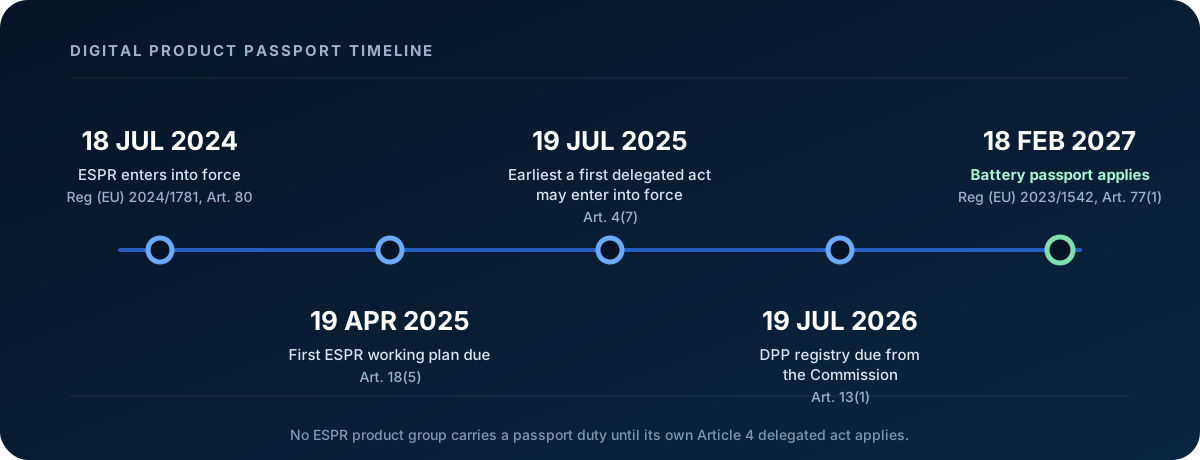
Article 4(7) sets the floor: “The first delegated act to be adopted under this Article shall not enter into force before 19 July 2025.” And Article 4(4) builds in a runway — the date a delegated act applies must be set “not earlier than 18 months from its entry into force,” except in duly justified cases. So even after an act for your product group appears, you generally get around a year and a half before it bites.
Which groups go first is set by the Commission’s working plan. Article 18(3) requires a public plan covering at least three years, and Article 18(5) required the first one by 19 April 2025, prioritising these groups:
| Priority product group (ESPR Article 18(5)) |
|---|
| Iron and steel |
| Aluminium |
| Textiles, in particular garments and footwear |
| Furniture, including mattresses |
| Tyres |
| Detergents |
| Paints |
| Lubricants |
| Chemicals |
| Energy-related products (new requirements, or existing Directive 2009/125/EC measures under review) |
| Information and communication technology products and other electronics |
The Commission confirms on its ESPR page that it “adopted the first ESPR and Energy Labelling Working Plan in April 2025, setting out which products will be prioritised over the coming years.”
Cement gets its own clock. Article 18(6) says ecodesign requirements for cement are to be set “not earlier than 31 December 2028 and not later than 1 January 2030,” and only if the EU’s construction products framework still lacks adequate environmental and carbon-footprint requirements by then.
If your product sits on that priority list, treat a passport as something to plan for rather than something to panic about. If you’re genuinely unsure which EU rules touch what you sell, Clearlane’s free EU scope scanner gives a cited first-pass read across all five current EU compliance regimes from a product code or description. It’s for orientation, not a filing decision.
When does each ESPR date actually fall?
What has to go in the passport?
Article 9(2) of Regulation (EU) 2024/1781 lists what each product group’s delegated act must decide. It’s a useful checklist for anyone trying to guess the shape of a future obligation:
- the data to include in the passport, drawn from Annex III
- which data carrier or carriers to use
- the layout and positioning of that carrier
- whether the passport applies at model, batch or item level
- how the passport is made accessible to a customer before they’re bound by a sale contract
- which actors get access to which data
- who may create a passport or update its entries, and what they may change
- how long the passport must stay available
Article 9 also sets a standing quality duty that no delegated act can water down: “the data in the digital product passport shall be accurate, complete and up to date.”
Article 10 adds the essential requirements that apply whatever the product group. The passport must connect to a persistent unique product identifier through a data carrier that is physically present on the product. It must use open, interoperable data standards. And it may not store customers’ personal data without their explicit consent under Article 6 of Regulation (EU) 2016/679 — the GDPR.
Article 11 decides who can look. Access is free of charge, and the list of people entitled to it is long: customers, manufacturers, importers, distributors, dealers, professional repairers, independent operators, refurbishers, remanufacturers, recyclers, market surveillance authorities, customs authorities, civil society organisations and trade unions — each seeing whatever their product group’s delegated act grants them. Article 11 also requires the passport to survive the company behind it going insolvent, being liquidated, or simply ceasing to trade.
That last requirement is the one companies underestimate. A passport that dies with the business would be worthless to a recycler handling the product a decade later, so ESPR makes outliving you part of the specification.
Who is actually responsible for it?
Article 2(46) defines “economic operator” broadly — “the manufacturer, the authorised representative, the importer, the distributor, the dealer and the fulfilment service provider.” But the sharp duties in Chapter III land on one of them: the economic operator placing the product on the market.
Two concrete obligations sit on that operator. Article 10(3) requires them to give dealers and online-marketplace providers a digital copy of the data carrier or the unique product identifier within five working days of a request. Article 10(4) requires them to make a back-up copy of the passport available through a digital product passport service provider when the product is placed on the market.
Beyond that, Article 9(2), point (g), leaves it to each delegated act to name “the actors that are to create a digital product passport or update the data in a digital product passport and what data they may introduce or update.” So in a long supply chain, who fills which field is a product-group question, not a general one.
What is the digital product passport registry?
A central EU database of passport identifiers, not of passport content. Article 13(1) of Regulation (EU) 2024/1781 requires the Commission to set up a registry storing at least the unique identifiers, plus commodity codes for goods entering free circulation and battery identifiers under Article 77(3) of Regulation (EU) 2023/1542 — and to do so “by 19 July 2026.” The Commission met that obligation — the registry went live on 20 July 2026, and Commission Implementing Regulation (EU) 2026/1778 laying down its implementation arrangements has been in force since 6 August 2026.
Article 14 requires something separate and public: a web portal where stakeholders can search and compare data held in digital product passports.
Article 15 is where the registry reaches the border, and three switches have to close before it reaches you. The first is shut: the registry has been operational since 20 July 2026, and Commission Implementing Regulation (EU) 2026/1778 (OJ L, 2026/1778, 17.7.2026), which lays down its implementation arrangements under ESPR Article 13(5), has been in force since 6 August 2026 — so Article 15(1)’s condition, that the duty applies “from the moment the registry is operational”, is met. Two remain open: the interconnection with the EU Customs Single Window Certificates Exchange System (EU CSW-CERTEX) is not yet operational, and the identifier duty only touches a product once that product group’s Article 4 delegated act applies — and none has been adopted. Nothing reaches your customs declaration today.
Article 13(1) sets that 19 July 2026 date as an obligation on the Commission, not on you — and it has been discharged: the registry has been live since 20 July 2026, under Commission Implementing Regulation (EU) 2026/1778 (in force 6 August 2026). That act sets no date by which any economic operator must register anything; its only dated duty is on Member States, to appoint a designated national administrator by 18 February 2027 (Article 7(1)). Your registration duty and its date come from your product group’s own sectoral law.
Is the battery passport the same as the ESPR digital product passport?
No. They’re two different obligations under two different regulations, and only one of them currently has a date that binds products.
The battery passport comes from Regulation (EU) 2023/1542 on batteries and waste batteries. Article 77(1) requires that “from 18 February 2027 each LMT battery, each industrial battery with a capacity greater than 2 kWh and each electric vehicle battery placed on the market or put into service shall have an electronic record (‘battery passport’).” LMT means light means of transport — a sealed battery of 25 kg or less providing traction for wheeled vehicles like e-bikes, per Article 3(1), point 11.
Note what’s not in scope there: portable batteries and SLI batteries (the starting, lighting and ignition batteries in a conventional vehicle) carry no passport duty under Article 77(1).
| ESPR digital product passport | Battery passport | |
|---|---|---|
| Legal basis | Regulation (EU) 2024/1781, Articles 9–15 | Regulation (EU) 2023/1542, Articles 77–78 |
| Applies from | Only when the product group’s Article 4 delegated act applies | 18 February 2027 (Article 77(1)) |
| Covers | Any physical good in ESPR scope, group by group | LMT batteries, industrial batteries over 2 kWh, EV batteries |
| Access model | Free access for a listed set of actors, per delegated act (Article 11) | Three tiers: public, authorities only, and legitimate interest (Article 77(2)) |
| How it’s reached | Data carrier physically present on the product (Article 10) | QR code under Article 13(6), linked to a unique identifier (Article 77(3)) |
The two are meant to fit together. Article 78 of Regulation (EU) 2023/1542 requires the battery passport to be interoperable with other EU digital product passports, to be free to access for consumers and economic operators, to use open and machine-readable formats, and to “remain available after the economic operator responsible… ceases to exist or ceases its activity in the Union.”
If you place LMT, EV or larger industrial batteries on the EU market, 18 February 2027 is the date to work backwards from. Article 77(4) puts responsibility for keeping the passport “accurate, complete and up to date” on the economic operator that placed the battery on the market.
What should you do about it now?
Two things, and neither of them is buying software in a hurry.
First, confirm whether your products sit in one of the priority groups named in Article 18(5), or in the battery categories under Article 77(1) of Regulation (EU) 2023/1542. That tells you whether your horizon is years out — a priority group still waiting on its Article 4 delegated act, which then carries at least an 18-month runway under Article 4(4) — or the six months left before 18 February 2027 (Regulation (EU) 2023/1542, Article 77(1)).
Second, look at whether you could actually fill a passport today. The data most groups will need — where a component came from, what it’s made of, who handled it — usually already exists somewhere in a supply chain, scattered across supplier emails and spreadsheets. Finding out now that a tier-two supplier can’t tell you a material composition is a much cheaper discovery than finding out under a delegated act’s deadline.
Clearlane’s free EU scope scanner is the honest starting point: it tells you, with citations, which of the five EU regimes appear to touch your product. For the fuller cited walkthrough of ESPR and the passport, see the digital product passport guide.
Clearlane prepares and validates compliance evidence and hands it to you. It never files to a registry or a portal on your behalf.