
Submitting an EUDR due diligence statement — a DDS — is not one action. You submit it before the goods move, the EU Information System runs an automated risk check whose result you never see, and only after that check concludes does it hand you the reference number your customer will ask for. Once that number is made available you have 72 hours to amend or withdraw the statement, and four separate events can close that window before the 72 hours are up.
That last part is the bit most process diagrams miss. The steps below are the order the system actually works in, each one tied to the provision that sets it.
The short answer
- You must submit the DDS before the relevant product is placed on the market or exported — Article 4(2) of Regulation (EU) 2023/1115.
- On submission, the statement goes through automated electronic risk profiling, and the risk status it receives “shall not be disclosed to the Information System user” — Article 6(3) of Implementing Regulation (EU) 2024/3084, as amended.
- The reference number and a verification number are assigned without undue delay after that profiling concludes, and made available to you at that point — Article 7(1) and 7(2).
- A competent authority may delay making them available while it checks the goods — Article 7(3).
- You then have 72 hours from the moment the reference number was made available to amend or withdraw the statement — Article 5(1).
- Grouping, an announced check, the goods moving, or the reference reaching customs each shut that window early — Articles 5(2) and 5(3).
- An amended statement is re-profiled in full — Article 5(5).
Step 1 — Get the production data right before you touch the Information System
Nothing in the submission steps will rescue a bad plot file, so this is where the time goes.
Article 9(1)(d) of Regulation (EU) 2023/1115 requires you to hold “the geolocation of all plots of land where the relevant commodities that the relevant product contains, or has been made using, were produced, as well as the date or time range of production”. Article 2 defines that geolocation as latitude and longitude “using at least six decimal digits”, with polygons required for non-cattle plots over four hectares.
One requirement is easy to miss because it sits in the implementing act rather than the Regulation: where a relevant product contains or was made using wood, Article 4(2) of Implementing Regulation (EU) 2024/3084 requires you to enter “the full scientific names of the wood species” in the statement. Common names will not do, and that is a supplier conversation, not a form-filling one.
What actually belongs inside the statement is a longer answer than this article has room for — see what goes in an EUDR due diligence statement for the content requirements and the Information System’s size limits.
Before any of it reaches a filing queue, it’s worth knowing your coordinate file survives the format rules. Clearlane’s free EUDR GeoJSON validator checks structure, coordinates and geometry in your browser — the file never leaves it — and records the repairs it can make without changing what the file means. It’s a format and data-quality check, not a compliance verdict.
Step 2 — Pick the right service
There are three, and they are not interchangeable: the standard Due Diligence Statement route, the Simplified Declaration for eligible micro or small primary operators, and Verify Declaration for authorised downstream users checking someone else’s declaration. Being a small company does not by itself qualify you for the simplified route, and verifying an upstream declaration does not discharge your own duties.
If you’re integrating rather than using the web interface, what changed in EUDR Information System API V3 covers the three service contracts in detail.
Step 3 — Submit, and understand what you have just taken on
Article 4(1) of Implementing Regulation (EU) 2024/3084 puts submission in the Information System itself: users “shall submit and manage the Due Diligence Statements of relevant products in the Information System”, except where the statement is made available through the electronic interface referred to in Article 28(2) of Regulation (EU) 2023/1115.
The timing is not flexible. Article 4(1) of Regulation (EU) 2023/1115 requires due diligence “prior to placing relevant products on the market or exporting them”, and Article 4(2) adds that operators “shall not place relevant products on the market or export them without prior submission of a due diligence statement”.
Submission also carries weight of its own. Under Article 4(3), by making the statement available the operator “shall assume responsibility for the compliance of the relevant product with Article 3” — the provision requiring relevant products to be deforestation-free, produced in accordance with the relevant legislation of the country of production, and covered by a due diligence statement or simplified declaration. You are not filing a notification. You are accepting responsibility for a claim.
Step 4 — Wait through a check you are not allowed to see
Article 6(3) of Implementing Regulation (EU) 2024/3084 is blunt about it: “Upon its submission in the Information System, each Due Diligence Statement and Simplified Declaration shall be subjected to an automated electronic risk profiling and the Information System shall assign a risk status to each Due Diligence Statement and Simplified Declaration, which shall not be disclosed to the Information System user.” Article 6(5) says the same thing from the other side — the risk status “shall only be visible to the Information System actors”.
So a wait tells you nothing. A statement that takes longer has not been judged badly, and a fast one has not been approved. Reading a delay as a signal is inventing information the system deliberately withheld.
There is a second reason a wait can stretch, and this one is a real decision by a real person. Article 7(3) lets competent authorities delay making the numbers available in order to establish whether the products comply with Article 3 of Regulation (EU) 2023/1115. That delay “shall be as short as possible” and is bounded by Article 17(3) of the Regulation: suspensions end “within three working days or within 72 hours in the case of perishable relevant products”, extendable by additional three-working-day periods if the authority concludes it needs more time.
Note the two different 72-hour periods in this article. The one here is a suspension limit for perishable goods that only applies if an authority intervenes. The one in Step 7 is your amendment window, and it applies every time.
Step 5 — Collect three identifiers, not one
This is where teams build the wrong data model, because “the DDS number” is really three things arriving at two different moments.
Article 7(1) of Implementing Regulation (EU) 2024/3084 states: “The Information System shall, without undue delay after concluding the risk profiling referred to in Article 6, assign a reference number to the Due Diligence Statement and a declaration identifier to the Simplified Declaration submitted by the Information System user. At the same time, it shall assign a verification number associated with the Due Diligence Statement or Simplified Declaration.” Article 7(2) adds that these “shall be made available to the Information System user upon concluding the risk profiling”.
| What you hold | When you get it | What it is for |
|---|---|---|
| The submission’s technical handle (a UUID at API level) | Immediately on submission | Retrieving the statement’s status while profiling runs |
| Reference number (DDS) or declaration identifier (Simplified Declaration) | After risk profiling concludes | The number your downstream customers and customs need |
| Verification number | At the same moment as the reference number | Paired with the reference so a recipient can verify the declaration |
The UUID is the API-level handle rather than a creature of the legal text — it comes from the Commission’s Operator API V3 reference, linked from the EUDR Information System page, which also advises against high-frequency polling while you wait.
The practical consequence: you cannot promise a customer a reference number in the same conversation in which you submit. Any internal process that treats “submitted” and “referenced” as one status will stall at exactly the wrong moment.
Step 6 — Pass the reference number down the chain
Article 4(7) of Regulation (EU) 2023/1115 makes this an obligation, not a courtesy: operators “shall communicate to downstream operators and to traders further down the supply chain of the relevant products they placed on the market or exported the reference numbers of the due diligence statements or, if applicable, the declaration identifiers associated to those products”.
Your buyer is not being difficult when they chase you for it. They cannot complete their own file without it.
Step 7 — You have 72 hours, and four things can end it sooner
Here is the provision almost no summary carries. Article 5(1) of Implementing Regulation (EU) 2024/3084: “The Information System shall enable Information System users to amend or withdraw Due Diligence Statements within 72 hours after the reference number for the Due Diligence Statement was made available in the Information System.”
The clock starts when the reference number appears, not when you submitted. But four events close the door regardless of how much of the 72 hours is left.
| What closes the window | Provision |
|---|---|
| The statement was used as a reference in a grouped statement submitted by the same user | Article 5(2) |
| You were notified of an intention to check the statement or the product — for the period of the check | Article 5(3)(a) |
| The product was placed on the Union market or exported | Article 5(3)(b) |
| The reference number was provided or made available to customs authorities before release for free circulation or export | Article 5(3)(c) |
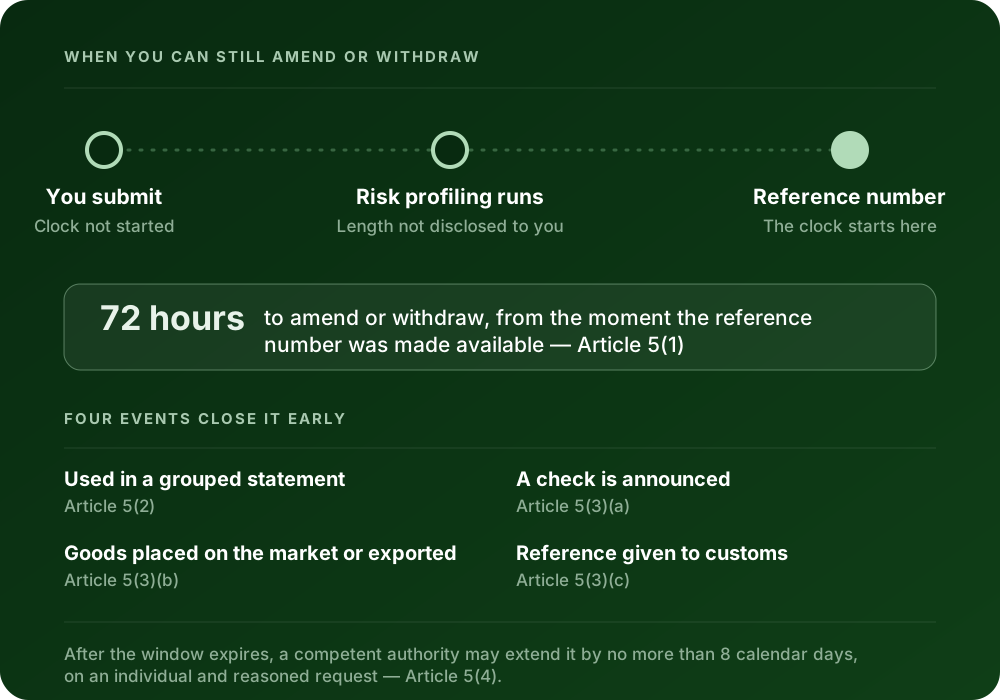
Read Article 5(3)(b) next to Article 4(2) of Regulation (EU) 2023/1115 and the squeeze becomes obvious. You must submit before the goods are placed on the market — and you lose the right to amend the moment they are. On a shipment that clears quickly, the real correction window can be a few hours, not three days. It is not a generous safety net, and planning as though it were is how a small data error becomes a permanent one.
There is one relief valve, and it is narrow. Article 5(4) allows competent authorities, “upon individual and reasoned request of an Information System user”, to extend the 72-hour period — but “only when such period referred to in paragraph 1 has expired”, and by no more than 8 calendar days. That is a discretionary decision on a reasoned request, made after your window has already closed. Do not design a process that assumes it.
One more thing to expect if you do amend in time: under Article 5(5), the amended statement “shall be subject to risk profiling as set out in Article 6”, and that profiling “shall apply to the whole amended Due Diligence Statement”. A correction is not a patch. It sends the entire statement back through Step 4, so you wait again.
So how should you sequence a shipment?
Three habits follow directly from the steps above, and none of them require a tool to adopt.
Validate the plot data before submission, not after. Once the reference number exists you are inside a 72-hour window that may already be shorter than it looks, and a data fix after the goods move is not available at all.
Treat “submitted” and “referenced” as two separate states in whatever system you keep. They are different moments with different downstream consequences, and collapsing them is what makes a customer’s request for a reference number turn into a scramble.
Group late. Grouping under Article 8a is something you choose to do, and Article 5(2) makes it a one-way door on every statement it references. Grouping once you are confident in the underlying data keeps your options open longer than grouping early.
What Clearlane does, and what it does not
Clearlane prepares and validates the work behind a due diligence statement, then hands it off. Deterministic scope and geolocation checks, GeoJSON repair that preserves meaning, production-country validation, and an audit trail you can show someone.
The boundary matters just as much. Clearlane does not submit a legally effective declaration to the EUDR Information System, does not issue an official reference or verification number, does not expose the Information System’s hidden risk status, and does not certify that goods are deforestation-free. A successful technical file check means the supported format and data-quality checks passed. Risk assessment, risk mitigation and the statement itself remain your responsibility as the operator.
Start where the failures actually are: check a GeoJSON file against the format rules — free, in your browser, about a minute. Then see how Clearlane’s preparation workflow fits together or read the plain-language EUDR guide.
This article is educational guidance. It is not legal advice, an Information System filing, or a compliance verdict.