
If you are searching for the EUDR deadline in 2026, the short answer is: there is no single date for every business.
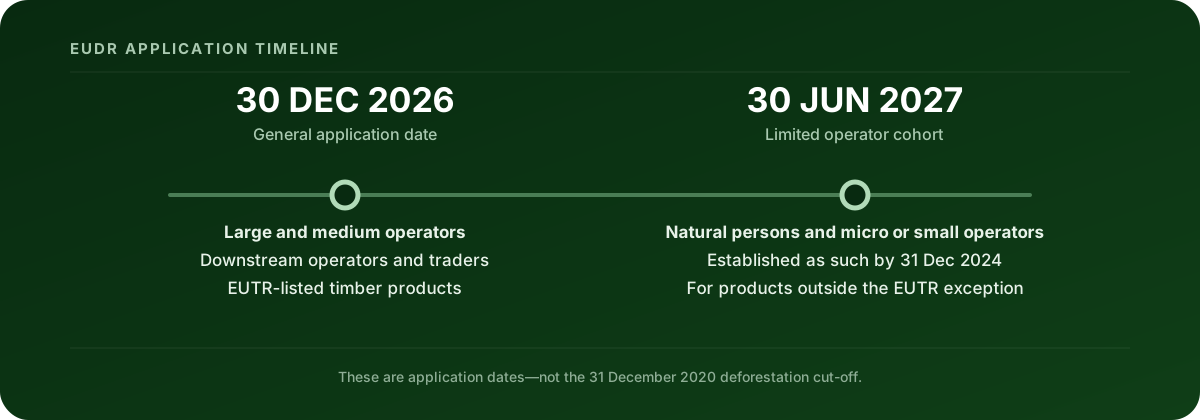
The general application date is 30 December 2026. A later date, 30 June 2027, applies only to a defined group of natural persons and micro or small operators—and not for products already covered by the EU Timber Regulation (EUTR).
That means company size is only one part of the answer. You also need to know your role in the supply chain, when the business was established as micro or small, and which product you are handling.
The EUDR deadlines at a glance
- 30 December 2026: large and medium operators; downstream operators and traders; and micro or small operators dealing in products already covered by the EUTR.
- 30 June 2027: natural persons and operators established as micro or small undertakings by 31 December 2024, for EUDR products outside the EUTR exception.
- 31 December 2020: not an application deadline. It is the EUDR’s deforestation cut-off date.
The dates and the limited later cohort are set out in Article 38 of the current consolidated EUDR text, as amended by Regulation (EU) 2025/2650. The European Commission’s July 2026 implementation update gives the same practical split.
Which EUDR date applies to you?
Use these three checks in order.
1. Identify your role for the product flow
An operator places a relevant product on the EU market for the first time or exports it. A downstream operator places on the market or exports a relevant product made using relevant products already covered by a due diligence statement or simplified declaration. A trader makes a relevant product available on the market without being an operator or downstream operator.
The role is attached to what the business does in a particular product flow. Do not decide it from a job title, company name or a generic “importer” label alone.
The 30 June 2027 exception in Article 38(3) is written for natural persons and qualifying micro or small operators. It is not a general later date for all small downstream operators and traders.
2. Check the size and establishment conditions
For the later date, the operator must be a natural person or have been established as a micro or small undertaking by 31 December 2024 under the accounting-size definitions referenced by the EUDR.
A medium-sized undertaking is part of the general 30 December 2026 cohort. A business that is small today should not assume the later date applies without checking whether it meets the legal cut-off and role conditions.
3. Check the EUTR product exception
Products already covered by the Annex to Regulation (EU) No 995/2010—the EU Timber Regulation—do not receive the Article 38(3) delay. For those timber and timber products, the relevant EUDR obligations apply from 30 December 2026, including for otherwise qualifying micro or small operators.
This is a product-level check. A company handling several product lines may therefore have different preparation paths inside the same business.
| Your situation | Application date to check |
|---|---|
| Large or medium operator | 30 December 2026 |
| Downstream operator or trader | 30 December 2026 |
| Natural person or micro/small operator established as such by 31 December 2024, handling a non-EUTR product | 30 June 2027 |
| Micro/small operator handling a product already covered by the EUTR | 30 December 2026 |
| Role, size or product classification is unresolved | Do not guess—resolve those facts before choosing a date |
Does the 2027 date mean small businesses can wait?
No. A later application date does not shorten the work needed to trace products back to their production places.
Before the applicable date, a business may need to:
- Confirm whether each product is in scope using its exact customs classification and description.
- Record whether it is acting as an operator, downstream operator or trader for that flow.
- Collect supplier, country-of-production and production-place information.
- Check whether plot geolocation is complete and usable.
- Decide whether the standard due diligence statement route or the Article 4a simplified-declaration route may apply.
- Keep the legal source, decision owner and review date behind the conclusion.
If you are still confirming product scope, Clearlane’s free EU scope scanner gives a cited first-pass map after you confirm the matching customs line. It is a screening tool, not legal advice or a filing decision.
If production-plot data is already arriving, the free EUDR GeoJSON validator checks supported geometry and format rules in the browser. It does not decide whether a product or shipment complies with the EUDR.
The deadline and the simplified declaration are different questions
Two small-business concepts are easy to mix up:
- Article 38 timing: determines when specified obligations begin to apply to a defined cohort.
- Article 4a simplified declaration: is a separate route for a qualifying micro or small primary operator that produces its own relevant commodities in a low-risk country.
Being micro or small does not automatically make a business a micro or small primary operator. It also does not automatically replace the standard due diligence statement with a simplified declaration.
The Commission’s current EUDR FAQ and the consolidated Regulation should be checked together when the role or route is uncertain.
Frequently asked questions
Was the EUDR delayed until 2027?
Not for everyone. The general application date is 30 December 2026. The 30 June 2027 date is limited to the Article 38(3) operator cohort and excludes products already covered by the EUTR.
What is the EUDR deadline for SMEs?
“SME” is too broad to determine the date by itself. Medium operators fall under 30 December 2026. A natural person or qualifying micro or small operator may fall under 30 June 2027 for non-EUTR products, subject to the role and establishment conditions. Downstream operators and traders should use the general date — Article 38(3) names operators and never names traders, so being a micro or small trader does not move you to June 2027.
Is 31 December 2020 an EUDR deadline?
It is the deforestation cut-off, not the business application date. Under Article 2(13), “deforestation-free” requires relevant commodities to have been produced on land that has not been subject to deforestation after 31 December 2020.
Are micro and small businesses exempt from the EUDR?
No. The Regulation contains differentiated dates and simplified provisions, but those are conditions and routes—not a blanket exemption.
Can software tell me which deadline applies?
Software can organize cited scope, product, role and company-size facts. The accountable business still needs to confirm the legal classification and resolve ambiguous product descriptions or roles. Clearlane does not provide legal advice or issue an official EUDR filing reference.
What to do next
Start with the decision that can invalidate everything downstream: confirm the product scope and your role for that flow. Then collect supplier and production-place data early enough to correct missing or unusable geolocation before the applicable date.
For the current product boundary, see how Clearlane’s EUDR preparation workflow works and the plain-language EUDR guide.