
CBAM stands for the Carbon Border Adjustment Mechanism — the EU’s system for putting a carbon cost on certain goods imported from outside the EU. It exists so that a steelmaker in, say, Turkey or India faces roughly the same carbon cost as a steelmaker in Germany, instead of EU industry just buying from wherever carbon isn’t priced.
What is CBAM, in one sentence?
Regulation (EU) 2023/956 establishes CBAM “to address greenhouse gas emissions embedded in the goods listed in Annex I on their importation into the customs territory of the Union in order to prevent the risk of carbon leakage” (Article 1(1)). “Carbon leakage” is the fear that drives the whole thing: if the EU makes its own producers pay for carbon but lets in cheaper, carbon-heavy imports, production just moves outside the EU and global emissions don’t actually fall.
Article 1(3) ties CBAM directly to the EU Emissions Trading System (ETS) — the carbon market EU manufacturers already pay into. CBAM is designed to replace the free-allowance protections that Directive 2003/87/EC currently gives EU industry against carbon leakage, applying an equivalent cost to imports instead.
Which goods does CBAM actually cover?
Article 2(1) applies CBAM to goods listed in Annex I of the Regulation, identified by their Combined Nomenclature (CN) customs codes, when they’re imported from a third country into the EU. The European Commission groups those Annex I goods into six sectors:
| Sector | What it covers |
|---|---|
| Cement | Cement and related clinker products |
| Iron and steel | Primary iron and steel, and a range of downstream articles — including screws and bolts (7318) and other articles of iron or steel (7326) |
| Aluminium | Primary and semi-finished aluminium, and downstream articles across headings 7610–7616 |
| Fertilisers | Nitrogen-based fertilisers |
| Electricity | Imported electricity |
| Hydrogen | Imported hydrogen |
If your product isn’t on one of these CN code lists, CBAM doesn’t apply to it — there’s no general “carbon tax on all imports.” Check the code rather than the sector name, because the downstream articles above surprise people who assume CBAM stops at raw metal. One heading, 2507 00 80, is an ex line that the CN code alone cannot decide: there the product facts settle it. Article 2 also carves out certain third countries and territories listed in Annex III.
Who actually has to comply?
Only an authorised CBAM declarant may import Annex I goods into the EU (Article 4). Article 3(17) defines that as a person specifically authorised by a competent national authority under Article 17 — it isn’t automatic just because you’re the importer of record.
Article 3(15) defines “importer” as either the person lodging the customs declaration for release into free circulation, or, where an indirect customs representative lodges it, the person on whose behalf that happens. In practice: if you’re the business bringing covered goods into the EU, you (or your customs representative) need CBAM authorisation before those goods clear customs.
Has CBAM already started, or is it still coming?
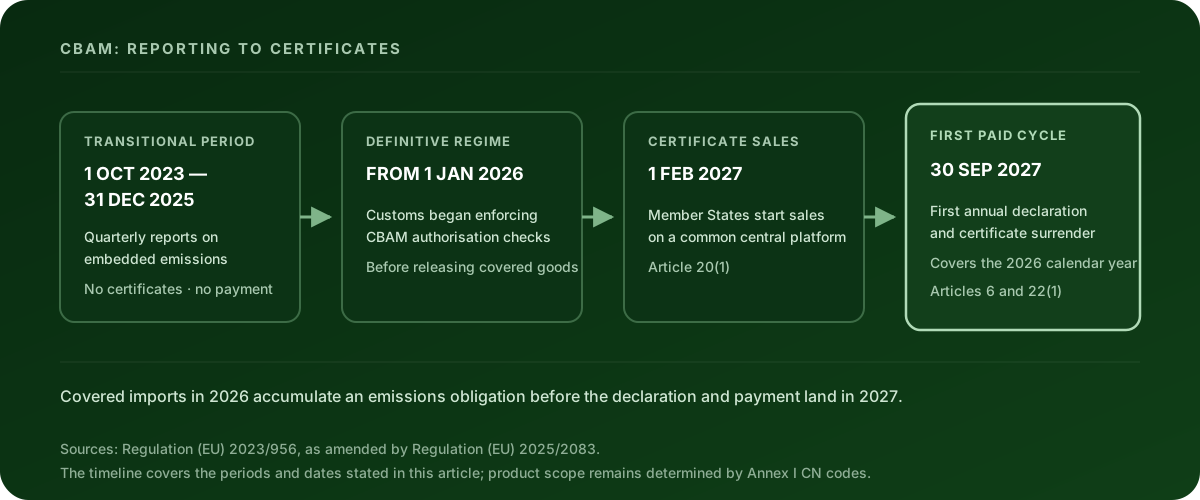
Both, depending on what you mean by “started.” CBAM phased in over two periods:
- Transitional period (1 October 2023 – 31 December 2025): importers had to submit quarterly reports on embedded emissions through the CBAM Transitional Registry. No certificates, no payment — just reporting.
- Definitive regime (from 1 January 2026): the CBAM Registry — established under Article 25 of the Regulation and Commission Implementing Regulation (EU) 2024/3210 — integrated with national customs systems, TARIC and the EU Customs Single Window, and Customs began enforcing CBAM authorisation checks before releasing goods. This describes the operational build-out rather than a deadline set by the act.
So the reporting-only phase is over, and the enforcement infrastructure is live. What hasn’t happened yet is the first paid declaration cycle.
When do the actual declarations and payments start?
Later than you might expect. Regulation (EU) 2025/2083, in force from 20 October 2025, amended the original CBAM Regulation to simplify the run-up to the definitive regime. It moved the annual declaration and surrender deadline from 31 May to 30 September, and pushed certificate sales and the quarterly-holding duty back to 2027.
- Article 6: the first CBAM declaration is due by 30 September 2027, covering embedded emissions for the 2026 calendar year.
- Article 22(1): authorised declarants must surrender CBAM certificates matching those declared emissions by the same date — 30 September 2027, for 2026.
- Article 20(1): Member States start selling CBAM certificates on a common central platform from 1 February 2027.
So if you’re importing covered goods in 2026, you’re accumulating an emissions obligation now, but the paperwork and payment land in 2027.
Is there a small-importer exemption?
Yes — and it’s worth checking before assuming CBAM applies to you at all. Article 2a, inserted by Regulation (EU) 2025/2083, exempts an importer whose cumulative net mass of CBAM goods in a calendar year stays under a “single mass-based threshold” laid down in point 1 of Annex VII. Recital (3) of that amending regulation says the threshold should “initially be set at a level of 50 tonnes”, aggregated across all CN codes, per importer, per calendar year. Note the word “initially”: the figure sits in an annex precisely so it can be revised, so check the current Annex VII before relying on it.
Two catches worth knowing:
- It’s all-or-nothing. Article 2a(2) says that if you exceed the threshold in a given year, you’re subject to full CBAM obligations for all embedded emissions in everything you imported that year — not just the tonnes above the threshold.
- Electricity and hydrogen never qualify. Article 2a(4) excludes both sectors from the exemption entirely, whatever the volume.
Is CBAM a tax?
Not in the legal sense — it’s a certificate-surrender mechanism tied to embedded emissions, mirroring how EU producers pay into the ETS. But the practical effect for an importer is the same as a cost: you calculate embedded emissions, then pay for certificates covering them. Whether you call that a tax or a levy, budget for it the same way.
What should I do now if I import covered goods?
Start by confirming whether your specific CN codes actually sit in Annex I — CBAM is sector-specific, not a blanket import charge. Clearlane’s free EU scope scanner gives a cited, first-pass read on which EU rules — including CBAM — apply to a product code or description, across all five current EU compliance regulations. It’s a screening tool for orientation, not a filing decision, and it never claims to submit anything to a registry on your behalf.
For the fuller CBAM picture — scope, timelines and what a declaration involves — see Clearlane’s CBAM explainer.