
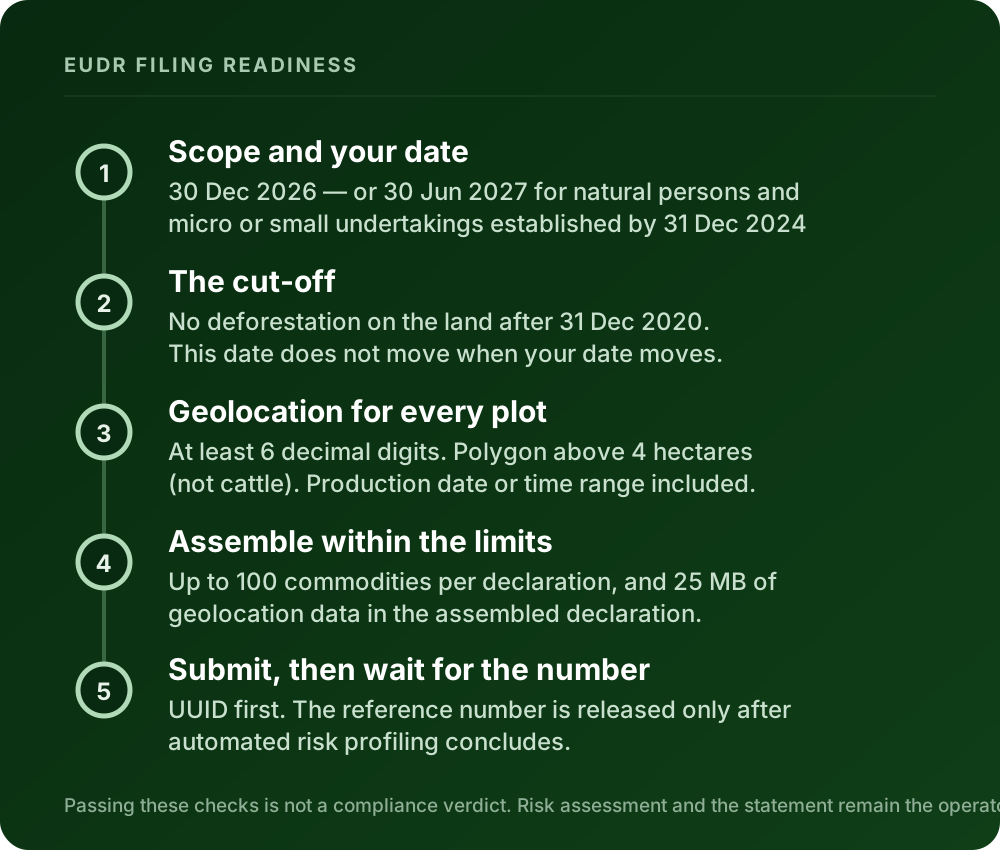
Five things have to be true before an EUDR filing is worth submitting: the products are in scope, no land behind them was deforested after 31 December 2020, you hold geolocation for every plot, that geolocation meets the format rules, and you are on the right declaration route. Everything below hangs off those five.
The order matters more than the length of the list. Chasing a supplier for a coordinate file costs you a fortnight of emails. Discovering at submission that nobody ever asked for one costs you the shipment.
Which EUDR date applies to you?
Two, and which one you get depends on what your business is rather than what it sells. Article 38 of Regulation (EU) 2023/1115, as replaced by Regulation (EU) 2025/2650 of 19 December 2025 (OJ 23.12.2025), sets them:
| Who you are | The duties apply from |
|---|---|
| Operators and traders generally — including micro and small traders | 30 December 2026 |
| Natural persons, and operators established as micro or small undertakings by 31 December 2024 | 30 June 2027 |
That second row is narrower than it looks, in two ways. It turns on being a natural person or a micro or small undertaking by 31 December 2024 — and Article 38(3) extends only to operators. It never names traders, so a micro or small trader takes the general 30 December 2026 date whatever its size. It also does not cover every product — the fuller conditions, including the exception for products already caught by the old EU Timber Regulation, are in EUDR deadlines in 2026 and 2027.
If you’re not sure which cohort you’re in, assume the earlier date while you find out. Being early is cheap; being late is not.
Is 31 December 2020 a deadline?
No. It’s the cut-off, and it’s a different kind of date entirely.
Article 2, point (13) of Regulation (EU) 2023/1115 defines “deforestation-free” as commodities “produced on land that has not been subject to deforestation after 31 December, 2020; and in the case of relevant products that contain or have been made using wood, that the wood has been harvested from the forest without inducing forest degradation after 31 December, 2020”.
The cut-off doesn’t move when the application dates move. Land cleared in 2021 does not become filable because your own duties start in 2027. This trips people up often enough to be worth saying plainly: the 2026 and 2027 dates say when you must comply, and 31 December 2020 says what compliance means.
Step 1 — confirm the products are actually in scope
Scope is decided by the regulation’s own commodity and product lists, not by what your industry calls the goods or what your supplier assumes. A product can be in scope because of an ingredient several steps upstream.
Two practical notes. Goods are identified in the EUDR Information System by their customs classification, and the Commission’s Operator API V3 reference documents HS headings of two to six digits — so the classification precision you carry in your own systems has to survive into the filing. And scope is a per-product question, not a per-company one: a business can have one line in scope and the rest of its catalogue out.
If you want a first pass rather than a legal opinion, Clearlane’s free EU scope scanner checks products against the current EU scope rules — no account, no upload. Treat the result as a shortlist to verify, not as a finding.
Step 2 — collect geolocation for every plot, and the production dates with it
This is where the real work sits, and it’s the step that most often isn’t finished when someone thinks it is.
Article 9(1)(d) of Regulation (EU) 2023/1115 requires “the geolocation of all plots of land where the relevant commodities that the relevant product contains, or has been made using, were produced, as well as the date or time range of production; where a relevant product contains or has been made with relevant commodities produced on different plots of land, the geolocation of all different plots of land shall be included”.
Read the middle clause again: the date or time range of production travels with the coordinates. A file that has perfect polygons and no production dates is an incomplete file, and plenty of supplier templates in circulation omit them.
The format rules come from the same regulation’s definition of geolocation, read with Article 9(1)(d):
| Production place | What the geolocation may be |
|---|---|
| Plot of four hectares or less, not cattle | A single latitude/longitude point — a polygon is fine too |
| Plot larger than four hectares, not cattle | A polygon with enough points to describe the plot’s perimeter |
| Establishment where cattle were kept | A single point, whatever its area |
Coordinates need at least six decimal digits of latitude and longitude. That’s a floor, not a target, and precision is easy to lose quietly — a supplier’s spreadsheet rounds to four decimals, a conversion drops digits, and the file still opens fine. The point-versus-polygon rule applies to the individual plot, not to the total size of the farm or the cooperative; when to use a point or a polygon works through the edge cases.
Check the file now, not at submission. Clearlane’s free EUDR GeoJSON validator checks structure, coordinates, geometry and precision in your browser, shows the plots on a map, and records the repairs it can make without changing what the file means. The file never leaves the browser. It’s a format and data-quality check — see the last section for what that deliberately does not mean.
Step 3 — pick the right declaration route before you build the file
The Information System separates three jobs, and getting this wrong costs a filing cycle:
| Service | Who it’s for |
|---|---|
| Due Diligence Statement | Operators making a standard declaration, and their authorised representatives |
| Simplified Declaration | Eligible micro or small primary operators, and their authorised representatives |
| Verify Declaration | Authorised downstream users checking an upstream declaration’s authenticity and status |
A Simplified Declaration is not a shorter filing route for every small business — it’s a specific route for an eligible micro or small primary operator. Being small doesn’t qualify you on its own.
And verification isn’t delegation. Checking an upstream declaration tells you that declaration is authentic and in a usable status. It does not move the upstream operator’s due diligence onto your file or discharge your own duties under Regulation (EU) 2023/1115.
Step 4 — size the statement against the documented limits
If you’re consolidating a lot of suppliers into one filing, the ceilings decide how you batch. The Commission’s May 2026 Operator API V3 reference, linked from the EUDR Information System page, documents these:
| Limit | Documented ceiling |
|---|---|
| Commodities per declaration | 100 |
| Producers per commodity | 1,000 |
| Producers per declaration | 10,000 |
| Scientific-name and common-name pairs per commodity | 500 |
| Grouping references | 2,000 |
| Geolocation data in the assembled declaration | 25,000,000 bytes |
| HS heading length | Two to six digits |
The 25,000,000-byte ceiling applies to the assembled declaration, not to the files you started from. It is a decimal byte count, not the 1,048,576-byte “MB” some file managers report — a file those tools call 24.5 MB is about 25.7 million bytes, already over. A set of individually reasonable polygon files can pass every upload check and still overflow the finished statement, so the size worth measuring is the one at the end.
Grouping has a boundary that surprises people: it covers eligible declarations previously submitted by the same Information System user, or declarations submitted for the same operator by its authorised representative. Holding a reference your supplier gave you does not make it eligible for same-user grouping.
Step 5 — record the country classification, and don’t over-read it
Implementing Regulation (EU) 2025/1093 classifies the countries in its Annex as low or high risk. Four are classified high risk: Belarus, North Korea, Myanmar and Russia. Every country not listed in the Annex stays standard risk — the absence of a country from the list is itself the answer, so there’s nothing missing to chase.
Two cautions worth building into your process. The standard-risk default applies to a valid ISO 3166-1 alpha-2 country code; a missing or malformed code isn’t standard risk, it’s an unresolved field, and it should fail your own checks rather than pass them quietly. And country classification is one input to the EUDR risk framework — it is not a finding that a plot, product or shipment is deforestation-free, legally produced or compliant. A low-risk origin does not make a statement true.
Step 6 — plan for the reference number arriving late
Your customers will ask you for a reference number, and it does not exist at the moment you press submit.
Implementing Regulation (EU) 2026/1565, which applies from 17 July 2026, sets the lifecycle: after submission the Information System makes the declaration UUID available first, the declaration then goes through automated electronic risk profiling, and only after that concludes does the system assign and release the reference number or declaration identifier and the verification number.
Three consequences for your process:
- Hold the UUID. It’s the handle you have during the gap, and any integration that discards it has lost track of its own filing.
- Never promise a buyer a reference number in the same conversation in which you submit. Two steps, two moments.
- A delay is not a verdict. The risk status the system assigns is not disclosed to the Information System user, so a wait that feels long tells you nothing. Inferring a hidden status from the delay — and worse, showing that inference to a customer — is inventing information the system deliberately withheld.
Amendment and withdrawal are separate lifecycle events and don’t erase the original submission history. The technical detail for teams building against the API is in what changed in EUDR Information System API V3.
What this checklist cannot tell you
A checklist gets your inputs straight. It is not due diligence, and it would be dishonest to imply otherwise.
A passing technical file check means the supported format and data-quality checks passed. It does not mean the Information System accepted a declaration, and it is not a legal or compliance verdict. Satellite and remote-sensing evidence can support a risk assessment and can flag a change worth investigating, but on its own it doesn’t prove goods are deforestation-free, legally produced or correctly linked to your supply chain.
Risk assessment, any mitigation it calls for, and the statement itself remain the operator’s responsibility. That’s not a disclaimer bolted on the end — it’s the shape of the regulation.
Frequently asked questions
What is the hardest part of an EUDR compliance checklist?
Geolocation. Article 9(1)(d) of Regulation (EU) 2023/1115 requires the location of every plot behind the product plus its date or time range of production, at six decimal digits, with polygons for plots over four hectares. Everything else is admin by comparison.
Does a clean GeoJSON file mean I’m EUDR compliant?
No. A file check confirms structure, coordinates, geometry and precision. Compliance under Regulation (EU) 2023/1115 also requires risk assessment, any mitigation, and a submitted statement — and none of those are things a file can demonstrate.
Can Clearlane file my EUDR declaration for me?
No, and be wary of anyone who says they can. Clearlane prepares and validates the work behind a declaration — deterministic scope and geolocation checks, meaning-preserving GeoJSON repair, production-country validation, and an audit trail you can show an authority — and then hands it off. Submitting to the Information System stays with you.
Start with the file you already have
The fastest way to find out where you actually stand is to run a supplier file through the checks. Validate an EUDR GeoJSON file in your browser — free, no account, and the file never leaves your machine. If your question is which products are caught in the first place, start with the EU scope scanner instead.