
EUDR simplified due diligence is Article 13 of Regulation (EU) 2023/1115: where every relevant commodity and product was produced in a country classified as low risk, you are not required to fulfil the obligations under Articles 10 and 11 — the risk assessment and risk mitigation. You still exercise due diligence, and you still submit a due diligence statement.
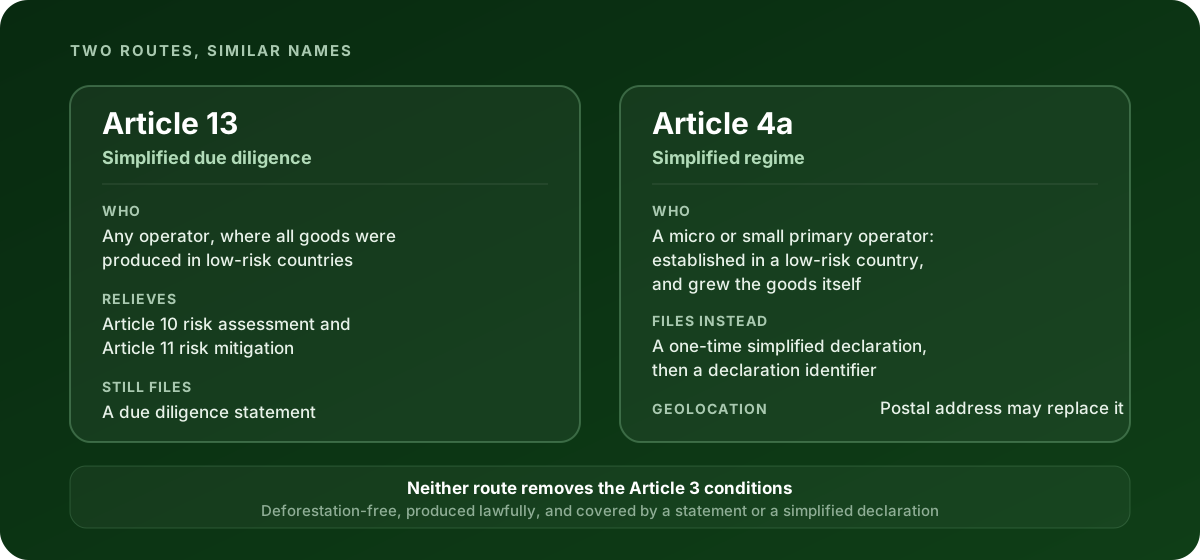
It is a different thing from the Article 4a simplified declaration, which is a one-time filing available only to micro and small primary operators. The names are almost the same. The routes are not, and most people who think they qualify for the second one actually don’t.
What is the difference between Article 13 and Article 4a?
| Article 13 — simplified due diligence | Article 4a — simplified regime | |
|---|---|---|
| What it relieves | The Article 10 risk assessment and the Article 11 risk mitigation | Article 4(2), Article 4(3) second sentence, and Article 4(4)(c) |
| Who can use it | Any operator, if all the goods came from low-risk countries | Only a micro or small primary operator — a grower, in a low-risk country |
| What you file | A due diligence statement, per Article 4(2), as normal | A one-time simplified declaration, not a statement per consignment |
| What you get back | A reference number | A declaration identifier |
| Geolocation | Article 9(1)(d) applies as usual | May be replaced by a postal address, under Article 4a(5) |
| Where it is written | Article 13 | Article 4a and Annex III |
The overlap that causes the confusion is that both routes lean on the same country classification in Article 29. Beyond that they answer different questions. Article 13 asks where did the goods come from. Article 4a asks who are you.
What does Article 13 simplified due diligence actually remove?
Articles 10 and 11, and nothing else.
Article 13(1) sets the condition carefully. Having assessed the complexity of the relevant supply chain and the risk of circumvention of the Regulation or the risk of mixing with products of unknown origin or origin in high-risk or standard-risk countries, you must have ascertained that all relevant commodities and products were produced in countries, or parts of countries, classified as low risk under Article 29.
That assessment is the work that earns the relief — it isn’t a box to tick. And you keep a duty afterwards: Article 13(1) requires you to make available to the competent authority, on request, relevant documentation showing there is a negligible risk of circumvention or of mixing with products of unknown origin or from high-risk or standard-risk countries.
The relief also ends the moment your information changes. Under Article 13(2), if you obtain or are made aware of any relevant information — including from your own Article 13(1) assessment, and including a substantiated concern submitted under Article 31 — pointing to a risk that the products don’t comply or that the Regulation is being circumvented, you must fulfil all the obligations under Articles 10 and 11 and immediately communicate the information to the competent authority.
If you want the detail of what Articles 10 and 11 ask for when they do apply, that sits in our piece on the EUDR risk assessment and the negligible-risk test.
Does Article 13 mean I don’t file a due diligence statement?
No. Article 13 says nothing about Article 4.
Article 4(2) still stands: operators shall not place relevant products on the market or export them without prior submission of a due diligence statement. Article 3(c) frames the same point from the product’s side — a relevant product may be placed or made available on the market or exported only where it is covered by a due diligence statement or a simplified declaration, alongside the deforestation-free condition in Article 3(a) and the legality condition in Article 3(b).
So Article 13 is a lighter assessment, not a lighter filing. What goes into the filing itself is covered in what an EUDR due diligence statement contains.
Which countries count as low risk?
The classification comes from Commission Implementing Regulation (EU) 2025/1093, adopted under Article 29. Its Annex lists the low-risk and high-risk countries; a country that isn’t listed is standard risk.
Article 29(1) sets up three tiers, and the wording of the low-risk tier is worth reading closely: low risk means the assessment concluded there is sufficient assurance that instances of producing non-compliant commodities in that country are exceptional. Exceptional is not the same as impossible, which is exactly why Article 13(1) still asks you to think about mixing and circumvention.
One practical trap: Article 13 needs all of the goods to be low-risk sourced. A single standard-risk plot in an otherwise low-risk consignment puts you back on the full Articles 10 and 11 route.
Who counts as a micro or small primary operator?
This is where most of the misreading happens. Definition (15a) in Article 2 sets three tests, and you need all three.
- You are a natural person, or a micro or small undertaking, within the meaning of Article 3(1) and Article 3(2) first subparagraph of Directive 2013/34/EU respectively, irrespective of legal form.
- You are established in a country classified as low risk under Article 29.
- You produced the goods yourself — you place on the market or export relevant products that you have grown, harvested, obtained from or raised on relevant plots of land, or, for cattle, on establishments located in that country.
Read test 3 again if you are an importer. A small business in Hamburg buying cocoa from Côte d’Ivoire is not a micro or small primary operator, however small it is — it didn’t grow anything, and it isn’t established in the country of production. The route is built for the farmer, not the buyer.
There is one genuine softener in the definition. An operator that exceeds the limits on at least two of the three Directive 2013/34/EU criteria can still qualify if it can demonstrate that the parts of its balance sheet total, net turnover and average number of employees relating to the relevant commodities and products stay under the limits of at least two of those three. A large business with a small commodity arm is not automatically shut out.
The size figures themselves live in Directive 2013/34/EU rather than in the EUDR, so check them there before relying on the test.
What goes into the one-time simplified declaration?
Annex III lists it, and Article 4a(3) points at Annex III. Four items:
- Name and address, plus the EORI number where the goods enter or leave the market.
- Harmonised System code and a free-text description including the trade name, and a one-off estimated annual quantity intended to be placed on the market or exported — net mass with a percentage estimate or deviation, or where applicable volume or number of items. For goods entering or leaving the market, kilograms of net mass and, where applicable, the supplementary unit.
- Country of production and the geolocation of all plots of land — or the postal address of the establishment or of all plots. For cattle, that address or geolocation refers to all establishments where the cattle are kept.
- A confirmation, quoted in Annex III, that the operator “will exercise due diligence in accordance with Regulation (EU) 2023/1115” and will place the products on the market or export them “only if no or only a negligible risk is found” that they don’t comply with Article 3, point (a) or (b).
Point 4 is the one to sit with. The Article 4a route changes what you file, not whether you do the work.
It is one declaration rather than one per consignment, and Article 4a(2) says the operator is assigned a declaration identifier after submitting it. Article 4a(3) allows the operator to update the information after any major changes.
Can a small grower really use a postal address instead of geolocation?
Yes — that is Article 4a(5), and it is the most concrete thing in the whole regime.
For micro or small primary operators, the geolocation referred to in Article 9(1), point (d) may be replaced by the postal address of all plots of land, or the postal address of the establishment from which the relevant commodities were produced.
Everyone outside Article 4a provides geolocation as an information requirement under Article 9(1)(d) — coordinates for every plot, in a file the Information System will read. If that is you, the format is where the time goes, and it’s worth checking your file early rather than the week before you file. Our free EUDR GeoJSON validator checks structure, coordinates, geometry and precision in your browser, and offers meaning-preserving repairs; the file never leaves your machine. It’s a format and data-quality check, not a compliance verdict.
What if the information is already in a national database?
Article 4a(4) covers this, and it is easy to miss.
Where all the information listed in Annex III is available in a system or database that exists under Union or Member State law — other than the Information System referred to in Article 33 — the micro or small primary operator is not required to submit the one-time simplified declaration. The Member State makes that information available per operator in the Article 33 system instead.
The condition that survives: the operator places the products on the Union market or exports them only after having been assigned a declaration identifier. So the paperwork may already be done for you, but the identifier still has to exist before the goods move.
When do these routes start to apply?
Article 38(2) applies Articles 3 to 13, Articles 16 to 24 and Articles 26, 31 and 32 from 30 December 2026. Both Article 4a and Article 13 sit inside that range.
Article 38(3) sets a later date of 30 June 2027, and it is narrow: it covers operators who are natural persons or micro or small undertakings within the meaning of Article 3(1) or Article 3(2) first subparagraph of Directive 2013/34/EU, irrespective of legal form, who were established as such by 31 December 2024 — and it excludes products covered by the Annex to Regulation (EU) No 995/2010, the EU Timber Regulation.
Watch the overlap here, because the two size tests are not the same test. The Article 38(3) date turns on size plus an establishment date of 31 December 2024. The Article 4a definition turns on size plus a low-risk country of establishment plus primary production, with no establishment date at all. You can land in one and not the other. The EUDR deadline breakdown walks the dates on their own.
What neither route removes
The Article 3 conditions hold in both cases. Relevant commodities and products may be placed or made available on the market or exported only where they are deforestation-free, produced in accordance with the relevant legislation of the country of production, and covered by a due diligence statement or a simplified declaration.
Responsibility travels with the filing either way. Article 4(3) is explicit: by making the due diligence statement available to competent authorities or, in the case of micro or small primary operators, by submitting the simplified declaration referred to in Article 4a, the operator assumes responsibility for the compliance of the relevant product with Article 3.
Neither route is an exemption. Both are a lighter path through the same obligation.
Where Clearlane fits
Clearlane prepares and validates the EUDR evidence and files an SME needs — geolocation, product data, the statement contents — and hands them off. It does not submit to TRACES or any registry on your behalf, and no tool here issues a compliance verdict.
If you’re still working out whether your products are caught at all, the EU scope scanner confirms a CN 2026 product line and shows cited coverage across five EU law packs. If you already know you’re in scope and have a plot file, check it in the GeoJSON validator — free, in your browser, and it takes a minute.
Sources
- Regulation (EU) 2023/1115, consolidated text of 26 December 2025 — Article 2 definition (15a), Article 3, Article 4, Article 4a, Article 9(1)(d), Articles 10 and 11, Article 13, Article 29(1), Article 38, Annex III.
- Commission Implementing Regulation (EU) 2025/1093 — the current country classification adopted under Article 29.