
The difference is who files and who carries the liability. Under Regulation (EU) 2023/1115, an operator does the due diligence, submits a due diligence statement before the goods move, and takes responsibility for the product being compliant. A trader does not file anything. A trader has to hold and pass on the information that follows the product down the chain.
If you get this wrong, you either do a large amount of work you never owed, or you miss the one filing that keeps your goods moving. So it’s worth ten minutes.
The one question that decides it
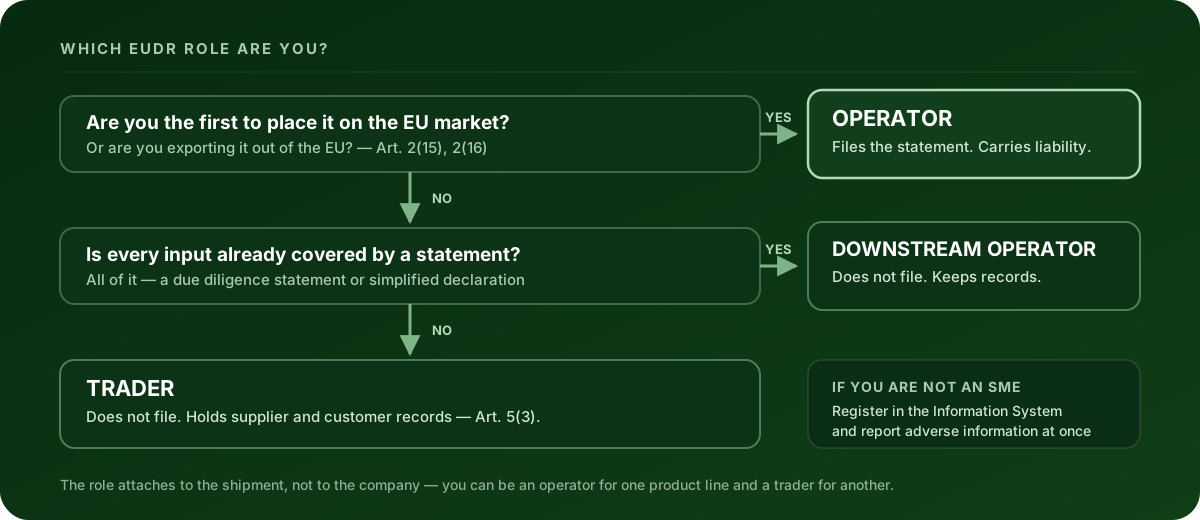
Are you the first person to put this product on the EU market?
That’s it. Article 2(16) defines “placing on the market” as “the first making available of a relevant commodity or relevant product on the Union market”. First touch. If you import cocoa from Ghana into Rotterdam, that first sale or transfer in the EU is you — you’re an operator. If you buy that same cocoa from a Dutch importer and sell it on to a chocolate factory, someone already placed it, and you’re further down the chain.
Exporting counts too. Article 2(15) defines an operator as “any natural or legal person who, in the course of a commercial activity, places relevant products on the market or exports them, excluding downstream operators”. Send in-scope goods out of the EU and you’re an operator for that shipment, even though nothing was imported.
The three roles, side by side
The regulation now has three, not two. The third one catches most people out.
| Operator | Downstream operator | Trader | |
|---|---|---|---|
| Who you are | First to place on the EU market, or an exporter | You make products from products already covered by a statement | Anyone else in the chain making products available |
| File a due diligence statement? | Yes — before the goods move | No | No |
| Carry responsibility for compliance? | Yes | No | No |
| Register in the Information System? | Yes | Only if you are not an SME | Only if you are not an SME |
| Keep records | 5 years | Yes, per Art. 5(3) | Yes, per Art. 5(3) |
A downstream operator is defined as someone who “places on the market or exports relevant products made using relevant products, all of which are covered by a due diligence statement or by a simplified declaration”. Read that “all of which” carefully — it’s the whole test. A chocolate maker whose cocoa is entirely covered by upstream statements is a downstream operator. Add one sack of cocoa that isn’t covered, and that chocolate maker is an operator, with everything that follows.
What an operator actually has to do
Three obligations, in this order.
Exercise due diligence first. Article 4(1) requires it “prior to placing relevant products on the market or exporting them”. Not after the container lands. Before.
File before you move. Article 4(2) is blunt: operators “shall not place relevant products on the market or export them without prior submission of a due diligence statement.” You submit it to the competent authorities through the EU Information System.
Own the outcome. Article 4(3) says that by making the statement available, “the operator shall assume responsibility for the compliance of the relevant product with Article 3.” That is the sentence that matters. Filing is not an administrative step — it is you putting your name to the claim. And you keep the statement for five years.
Then there’s a fourth thing that people forget: Article 4(7) requires you to pass the reference numbers of your statements down the supply chain to the downstream operators and traders who buy from you. Your filing is their evidence. If you don’t send the reference, you’ve broken their compliance, not just your own.
What a trader actually has to do
Much less — but not nothing.
Article 5(1) says downstream operators and traders may only place or make available products “if they are in possession of the information required under paragraph 3.” Paragraph 3 is the record-keeping duty: the name, registered trade name or trade mark, postal address, email and, where available, the web address of whoever supplied you — and the same for whoever you supplied.
So a trader’s job is to keep the chain intact. Know who you bought from. Know who you sold to. Hold the due diligence statement references that came with the goods.
Two extra duties land only on traders and downstream operators that are not SMEs:
- Registration. Article 5(2) requires non-SME downstream operators and non-SME traders to register in the Information System before placing, making available or exporting.
- Reporting — and, on a substantiated concern, stopping. Article 5(6) requires them, on obtaining or being made aware of relevant information indicating a product isn’t compliant, to “immediately inform the competent authorities.” Immediately. Not at the next audit. The same paragraph goes further than reporting: in the case of substantiated concerns they must verify that due diligence was exercised and that no or only a negligible risk was found, and they “shall not place or make available on the market or export relevant products unless the verification demonstrates no or only a negligible risk of non-compliance.” That is a hold on the goods, not just a notification.
“SME” here isn’t a loose word. The regulation ties it to Article 3(1), 3(2) first subparagraph, and 3(3) of Directive 2013/34/EU — a definition based on balance sheet total, net turnover and employee numbers. Check yourself against it rather than assuming.
The small-operator route
If you’re a micro or small primary operator, Article 4a offers a lighter path: a one-time simplified declaration in the Information System, before placing products on the market or exporting them. One declaration, not one per shipment.
This is narrow. It’s for micro and small primary operators specifically, and Article 4(3) still attaches responsibility for the product to the person who submits it.
When does this start applying to you?
Two dates, and which one you get depends on your size — not your role.
| Who | Applies from |
|---|---|
| Operators and traders other than micro and small enterprises | 30 December 2026 |
| Natural persons, and operators established as micro or small undertakings by 31 December 2024 | 30 June 2027 |
These come from Article 38(2) and — for the later cohort — Article 38(3), as amended by Regulation (EU) 2025/2650 — the second postponement, published 23 December 2025.
Read Article 38(3) closely, because it names operators and does not name traders. A micro or small trader is therefore not in the June 2027 cohort at all: traders take the general 30 December 2026 date whatever their size. The extension reaches natural persons and micro or small operators established as such by 31 December 2024, and nobody else.
One trap in the later date: products already covered by Regulation (EU) No 995/2010 — the old EU Timber Regulation — follow the general date, not the extension. So a small timber business does not automatically get until June 2027.
Common ways people get this wrong
“We’re just a distributor, so we’re a trader.” Maybe. But if you also import directly for any product line, you’re an operator for those, and a trader for the rest. The role attaches to the shipment, not to the company.
“Our supplier handles the filing.” If your supplier is outside the EU, they cannot be the operator — the operator is whoever first places the goods on the EU market, and that’s the importer. Which is probably you.
“We’re a downstream operator, so we’re covered.” Only if all the inputs are covered by a statement or simplified declaration. One uncovered input and the role changes.
“We’re an SME, so registration doesn’t apply.” Registration exemption is for downstream operators and traders. If you’re an operator, you file, whatever your size.
How to work out your own answer
Walk it in this order:
- Is the product in scope? (Cattle, cocoa, coffee, oil palm, rubber, soya, wood — and things made from them.)
- Am I the first to place it on the EU market, or am I exporting it? → Operator.
- Is everything I use already covered by upstream statements? → Downstream operator.
- Otherwise → Trader.
- Then check your size against Directive 2013/34/EU, because that decides registration, reporting and your start date.
If step 1 is where you stall, that’s normal — scope is genuinely fiddly, and getting it wrong in either direction is expensive.
Check whether your products are in scope — it’s free and takes a minute. No account needed to start.
Related reading: what the EUDR is and who it applies to, what goes into a due diligence statement, and the 2026 deadline in detail.
Sources
- Regulation (EU) 2023/1115, consolidated text of 26 December 2025 — Articles 2, 4, 4a, 5, 38
- Regulation (EU) 2025/2650 — role simplification and the current application dates
- Directive 2013/34/EU — the SME definition the regulation points to
This article explains the regulation. It is not legal advice, and your competent authority is the authority on your specific case.