
The EUDR is the EU Deforestation Regulation — Regulation (EU) 2023/1115. It stops seven commodities, and the products made from them, from being sold or exported in the EU unless three things are true: they are deforestation-free, they were produced legally in their country of origin, and they are covered by a declaration you file yourself.
The seven commodities are cattle, cocoa, coffee, oil palm, rubber, soya and wood. If you place any of them on the EU market — or a product containing them, or fed with them — the regulation is talking to you.
Here’s the part most summaries skip. The EUDR doesn’t ask you to promise your supply chain is clean. It asks you to prove where every plot of land was, in coordinates, and to put your name on that statement before the goods move.
What does the EUDR actually ban?
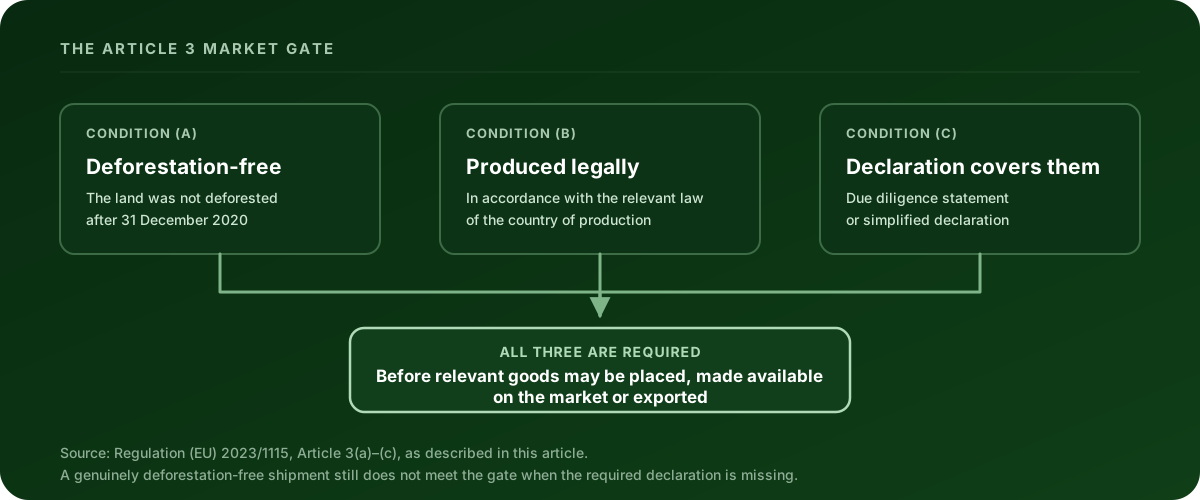
Article 3 is the whole regulation in one sentence. Relevant commodities and products cannot be placed on the market, made available on it, or exported unless all three of these conditions are met:
| The condition | What it means in practice |
|---|---|
| (a) They are deforestation-free | The land they came from was not deforested after 31 December 2020 |
| (b) They were produced in accordance with the relevant legislation of the country of production | Land tenure, labour, tax, trade and environmental law where the crop was grown — not EU law |
| (c) They are covered by a due diligence statement or a simplified declaration | You file it yourself, before the goods move |
All three, not the best two. A shipment can be genuinely deforestation-free and still be non-compliant because nothing was filed. That is the failure mode that catches most people, because it is administrative rather than agricultural.
Condition (c) reads that way because Regulation (EU) 2025/2650 amended it to add the simplified declaration route. Which route applies to you depends on your size and role — we cover that in the due diligence statement article.
Which products does the EUDR cover?
Article 1(1) names the seven commodities. But the regulation doesn’t stop at raw beans and logs — it covers the relevant products listed in Annex I that “contain, have been fed with or have been made using” those commodities.
That phrase does a lot of work:
- Contain — chocolate contains cocoa. A tyre contains rubber, if the rubber is natural.
- Have been fed with — beef and leather from cattle raised on soya feed.
- Have been made using — furniture, paper, charcoal.
So the reach is wider than the commodity list suggests. Annex I settles it by customs code, not by intuition — and the list has already been narrowed once. Regulation (EU) 2025/2650 deleted the ex 49 line that had put “printed books, newspapers, pictures and other products of the printing industry, manuscripts, typescripts and plans, of paper” in scope, so Chapter 49 printed matter is out. Pulp and paper of Chapters 47 and 48 stay in, except bamboo-based and recovered (waste and scrap) products — an exception written into Annex I itself, not into guidance. Check your code against the current consolidated Annex I rather than reasoning from the ingredient — or from an older copy of the list.
Annex I also carries its own waste carve-out in the text above the table: the regulation does not apply to goods produced entirely from material that has completed its lifecycle and would otherwise have been discarded as waste, except for by-products of a manufacturing process that did not involve waste.
Four narrowings that a customs code alone will not show you
The Commission’s guidance document for the EUDR (Commission Notice C/2026/4972, OJ C, C/2026/3896, 20 July 2026) reads the commodity definitions narrowly in four places. This guidance is non-binding and changes no obligation — it states the Commission’s reading, and only the regulation and the courts decide. But it tells you where a CN-code match may not settle the question:
| Commodity | The Commission’s reading |
|---|---|
| Cattle | Genus Bos only — not buffalo or bison |
| Oil palm | Elaeis species — not babassu |
| Rubber | Hevea — not guayule, and not synthetic |
| Wood | Excludes bamboo and rattan |
The Notice also treats packaging used in its own right as a product rather than as packaging, and reads reusable packaging as leaving scope from its first reuse.
That is why a wholly synthetic-rubber tyre can carry a listed CN code and still fall outside the commodity, and why “check the code” is the start of the answer rather than the whole of it. Where a code and a carve-out disagree, get the product facts before you file.
What counts as “deforestation-free”?
Article 2(13) gives a two-part definition, and the second part only applies to wood:
- The commodities were produced on land that has not been subject to deforestation after 31 December 2020; and
- for products containing or made using wood, the wood was harvested without inducing forest degradation after 31 December 2020.
31 December 2020 is a cut-off date, not a deadline. It is the line the land has to be clean since — nothing has to happen on that date, and it does not change when the regulation starts applying to you. It is the single most commonly misread number in the EUDR, which is why we gave it its own section in the compliance checklist.
“Deforestation” has a precise meaning here too. Article 2(3) defines it as the conversion of forest to agricultural use, “whether human-induced or not” — so a forest lost to fire or flood and then farmed still counts. And a “forest” under Article 2(4) is land spanning more than 0.5 hectares, with trees higher than 5 metres and canopy cover above 10 %, or trees able to reach those thresholds where they stand.
Those numbers matter because they decide whether a piece of land was a forest in the first place.
Does the EUDR apply to you — and as what?
The regulation splits the supply chain into roles, and your obligations follow the role, not the size of the company.
| Role | Definition | Core duty |
|---|---|---|
| Operator | Places relevant products on the market or exports them, in the course of a commercial activity — excluding downstream operators (Art. 2(15)) | Exercise due diligence and file before the goods move (Art. 4) |
| Trader | Anyone else in the chain who makes relevant products available on the market (Art. 2(17)) | Obligations depend on size; a trader is not simply a lighter operator |
“Placing on the market” is defined in Article 2(16) as the first making available of a commodity or product on the Union market. So the importer bringing coffee into the EU is placing it on the market. The wholesaler who buys it afterwards is making it available.
If you import, you are almost certainly an operator. Article 4(1) requires operators to exercise due diligence before placing products on the market or exporting them, and Article 4(2) is blunt about the order of events: no placing on the market without prior submission of the statement.
What does EUDR due diligence actually involve?
Article 8(2) breaks it into three steps, in order:
- Collect information — the requirements in Article 9.
- Assess risk — Article 10.
- Mitigate risk — Article 11, where the assessment found more than negligible risk.
Step 1 is where almost all the real work sits. Article 9(1) requires you to collect, organise and keep for five years — with evidence — at least:
- a description of the products, including species names for wood, common and full scientific;
- the quantity, in kilograms of net mass for products entering or leaving the market;
- the country of production, and where relevant the parts of it;
- the geolocation of all plots of land where the commodities were produced, along with the date or time range of production.
That last one is the requirement that changes how a business operates. It is not a country of origin or a supplier name. It is coordinates, for every plot, for every consignment — and the EU checks the file by machine, so a formatting mistake fails the same way a missing plot does. What geolocation has to look like is its own subject, and the format is unforgiving.
If you already have plot data from your suppliers, you can find out in about a minute whether it would survive that check. Run it through the free EUDR GeoJSON validator — no account, no upload of anything you don’t choose.
When does the EUDR start applying?
There is no single date. The general application date is 30 December 2026, with a later date of 30 June 2027 for a narrow, defined group of micro and small operators — and not for products already covered by the EU Timber Regulation.
Working out which one is yours depends on your role, your size, when the business was established, and the product. We walk through all three checks here.
Three things the EUDR is not
Worth clearing up, because each one sends people down the wrong path.
It is not a certification scheme. There is no EUDR certificate to buy and no auditor whose sign-off transfers the obligation. The operator carries the responsibility, whatever a supplier’s paperwork says.
It is not a ban on any country. Commission Implementing Regulation (EU) 2025/1093 classifies countries as low, standard or high risk, and that classification changes how much checking you must do — not whether you may trade. Low risk does not mean no obligations.
It is not only about forests. Condition (b) of Article 3 — legal production in the country of origin — covers land rights, labour law and tax. A plot can be perfectly deforestation-free and still fail on tenure.
Frequently asked questions
Is the EUDR the same as the EUTR?
No, though they are directly connected. Regulation (EU) 2023/1115 repeals the EU Timber Regulation, Regulation (EU) No 995/2010 — but Article 37(1) sets that repeal to take effect from 30 December 2026, not earlier.
The old regulation also doesn’t vanish cleanly on that date. Article 37(2) keeps it applying until 31 December 2029 to timber and timber products, as defined in the EUTR, that were produced before 29 June 2023 and placed on the market from 30 December 2026. So for a few years the two regimes sit side by side for legacy timber stock.
The practical difference is scope: the EUTR covered timber and timber products, while the EUDR covers seven commodities and adds plot-level geolocation on top.
Does the EUDR apply to small businesses?
Yes, but not identically. Size changes the route and the timing — Regulation (EU) 2025/2650 introduced the simplified declaration and a later application date for a defined cohort of micro and small primary operators. It does not remove the obligation.
What happens if my supplier can’t give me coordinates?
Then you cannot complete Article 9(1)(d), and you cannot honestly file. This is the most common blocker in practice, and it is a sourcing conversation rather than a software one — although getting the request right, and in a format the farm can actually answer, makes a considerable difference.
Can Clearlane file my EUDR declaration for me?
No. Clearlane is a compliance platform, not a broker or a filing agent. We help you collect and validate the data, repair the geometry, and prepare a statement that will pass the EU’s checks — then you file it. The declaration stays yours, which is also where the legal responsibility sits.
Where to start
If the EUDR is new to you, the honest first step is not software. It is finding out whether your products are in scope at all, and whether the plot data you already hold would survive the EU’s validation.
Both are free and take a few minutes: check your products against the scope rules, then test your plot file in the GeoJSON validator. If they pass, you are further along than most. If they don’t, you will at least know exactly what to ask your suppliers for — and you’ll know it well before December.