
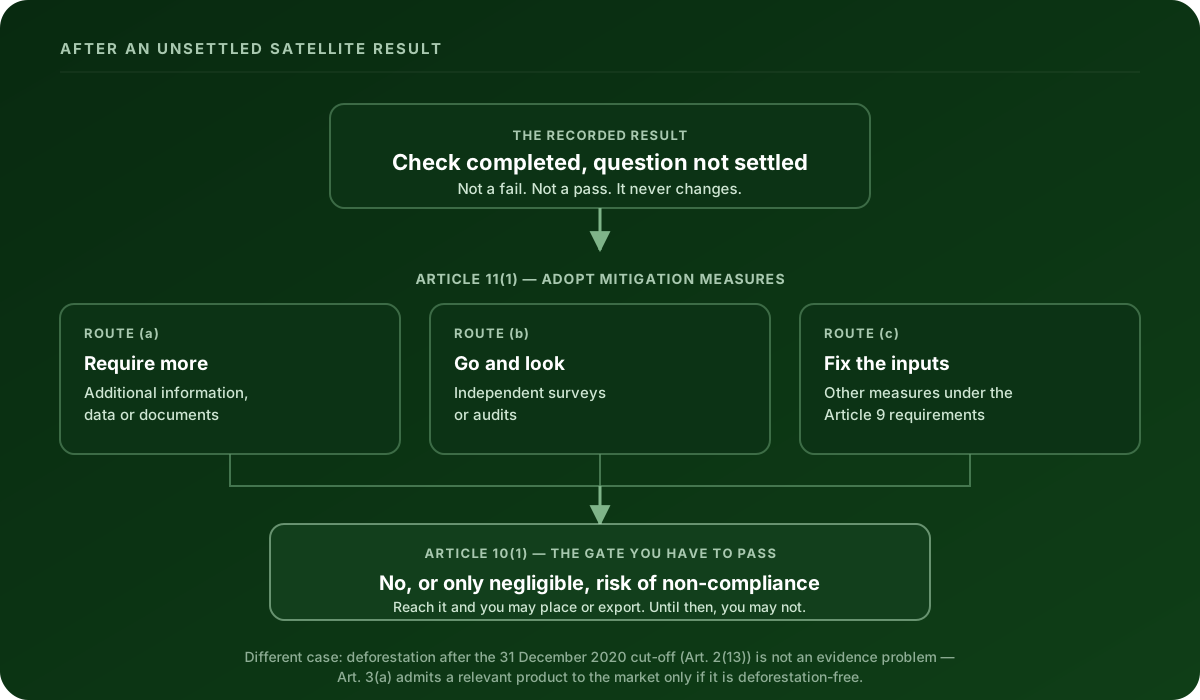
Needs evidence is not a fail, and it is not a pass. It means the satellite check finished without settling the deforestation question for that plot, so the decision goes back where Regulation (EU) 2023/1115 always put it — with you. Article 11(1) is the way out: you require additional information, commission an independent survey or audit, or take other measures under Article 9, then record what you concluded and why.
The thing most people expect next is the thing that never happens. The satellite result does not flip to clear. Nothing you add rewrites it, and a product that pretends otherwise is doing you no favours.
What does “needs evidence” actually mean?
Two things went right and one is still open. The check ran. The result was recorded. What it could not do is answer the deforestation question for this plot from the imagery available.
That happens for ordinary reasons: persistent cloud over the growing season, a canopy that closes over the plot boundary, gradual thinning that never reads as a clearance event, a parcel smaller than the imagery resolves, or a risk column the provider defines but has not published for your commodity yet.
None of that is a finding against your plot. It’s an absence of a finding, which is a different thing — and Regulation (EU) 2023/1115 never treated a satellite result as the decision anyway. Article 8(2) splits due diligence into three parts: collect the information (Article 9), assess the risk (Article 10), mitigate what the assessment turns up (Article 11). Remote sensing is an input to the middle step, not a substitute for it.
Article 10(2)(g) is explicit that judging your evidence is your job. Among the criteria your risk assessment must take into account is “the source, reliability, validity, and links to other available documentation of the information referred to in Article 9(1)”. That is an instruction to weigh what you were given, not to accept a machine’s word for it.
Can I still ship while a plot is unsettled?
Article 10(1) sets the bar in one sentence: operators “shall not place the relevant products on the market or export them, except where the risk assessment reveals no or only a negligible risk that the relevant products are non-compliant.”
Read that carefully, because it decides your week. You are not blocked by a bad verdict. You are blocked by an assessment that has not reached its conclusion. An open question is not the no-or-negligible-risk finding Article 10(1) requires, so until you close it, the regulation doesn’t give you the green light.
The good news is that closing it is a defined procedure, not a judgement call about whether you feel comfortable.
What does Article 11(1) let me do about it?
Article 11(1) applies “[e]xcept where a risk assessment carried out in accordance with Article 10 reveals that there is no or only a negligible risk that the relevant products are non-compliant” — which is exactly where an unsettled plot leaves you. It requires you to adopt mitigation procedures and measures “adequate to achieve no or only a negligible risk”, and it names three:
| Article 11(1) route | The regulation’s words | What that looks like on a Monday morning |
|---|---|---|
| (a) | “requiring additional information, data or documents” | Go back up the chain. Land title or lease documents, a producer declaration with dates, purchase records tying the volume to the plot, historical imagery or a ground photo set with coordinates. |
| (b) | “carrying out independent surveys or audits” | A field visit or third-party audit of the plot. Expensive, and the right answer when a plot matters enough or a supplier can’t produce records. |
| (c) | “taking other measures pertaining to information requirements set out in Article 9” | Improve the Article 9 information itself — better geolocation, tighter production dates, a cleaner link between the batch you bought and the plot it came from. |
The same paragraph adds a fourth option that is easy to miss and often the most realistic one for smallholder supply: mitigation “may also include supporting compliance with this Regulation by that operator’s suppliers, in particular smallholders, through capacity building and investments.”
One caveat worth having before you go shopping for a certificate. Article 10(2)(n) does allow complementary information from “certification or other third-party verified schemes” — but only “provided that the information meets the requirements set out in Article 9 of this Regulation.” A certificate that doesn’t carry plot geolocation and production dates isn’t a shortcut past Article 9. It’s a document about a document.
Why doesn’t the satellite result change once I’ve done the work?
Because they are two different facts, established by two different parties, on two different bodies of evidence. The imagery said what it said. Your assessment is your conclusion. Collapse them into one status word and the record loses the only distinction an auditor actually cares about.
Article 10(4) is why that matters in practice. You must “document and review the risk assessments at least on an annual basis and make them available to the competent authorities upon request”, and you must “be able to demonstrate how the information gathered was checked against the risk assessment criteria set out in paragraph 2 and how they determined the degree of risk.” You cannot demonstrate how you got from an unsettled check to a conclusion if the software has quietly overwritten the unsettled check.
So in Clearlane the recorded verdict stays exactly as it was, permanently. What changes is the statement about it: the plot moves from your assessment needed to your assessment recorded, and it stays amber. No screen says cleared, passed, or deforestation-free on the strength of an assessment you wrote — Article 3(a) admits a relevant product to the market only if it is deforestation-free, and your own assessment is not that finding.
If you are evaluating tools, that’s the behaviour to probe. Ask what the screen does when you type a justification into it. If it turns green, the vendor has just laundered your opinion into a detection result, and the record you’d hand an inspector no longer shows which is which.
What does my record have to show?
Both ends of the process carry a documentation duty, and they are worth reading together.
- Article 10(4) — risk assessments documented, reviewed at least annually, available to competent authorities on request, with a demonstration of how you weighed the criteria and determined the degree of risk.
- Article 11(3) — “The decisions on risk mitigation procedures and measures shall be documented, reviewed at least on an annual basis and made available by the operators to the competent authorities upon request. Operators shall be able to demonstrate how decisions on risk mitigation procedures and measures were taken.”
- Article 9(1) — the underlying information kept “for five years from the date of the placing on the market or of the export”, and under Article 9(2) made available to competent authorities on request.
In practice, a defensible file for one unsettled plot holds six things: what the check returned and when; which question it could not answer; what you required under Article 11(1) and from whom; what came back; the conclusion you reached, in your own words rather than a dropdown; and who at your company reached it, on what date.
Write the reasoning out properly. The version of you being asked about this in eighteen months will not remember why the shade trees explained the signal.
Is there a case where no amount of evidence helps?
Yes, and it’s worth knowing before you spend a week collecting documents.
Mitigation under Article 11(1) closes an open question. It does not reopen a closed one. Where the finding is deforestation after the cut-off rather than an unsettled answer, Article 3(a) is the wall: a relevant commodity or product may be placed on the market, made available or exported only if, among other conditions, it is deforestation-free.
And deforestation-free has a fixed meaning. Article 2(13) defines it as produced on land “that has not been subject to deforestation after 31 December, 2020”, and for wood, harvested “without inducing forest degradation after 31 December, 2020”. That date is not negotiable by evidence, and no risk-mitigation measure in Article 11 reaches it.
The practical consequence: triage before you invest. An unsettled plot is worth the Article 11(1) effort. A plot with a post-2020 conversion on it is a sourcing decision, not an evidence problem.
What if the gap is the provider’s, not my plot’s?
This one catches cattle operators in particular, and it deserves saying plainly because it looks like a bug.
Sometimes the check completes normally, the data is recorded, and there is still no answer — because the risk column that would answer the question for that commodity class is one the data provider defines but has not published yet. That is currently the case for the livestock risk axis. Re-running the check will never produce a different result, since nothing about your plot is the reason.
Regulation (EU) 2023/1115 handles this without difficulty, because it asked for the operator’s risk assessment in the first place. Article 10 puts the assessment on you, Article 10(4) puts the determination on you, and Article 11(1) authorises the further information you rely on to get there. A missing third-party column doesn’t suspend those obligations, and it doesn’t excuse them either. You assess, on the evidence you can actually obtain, and you record it.
What that must never become is a pass. The verdict stays what it was, the plot stays amber, and the record shows an operator assessment sitting next to an unanswered check — not in place of one.
Where to start
If you’re reading this with a plot stuck in front of you, the useful order is: work out whether the plot is unsettled or disqualified, then pick your Article 11(1) route, then write the reasoning down while it’s fresh.
And if you haven’t got as far as a satellite check yet, start further back — a file with broken geometry never reaches the analysis at all.
Check your plot data free, in your browser — it tells you exactly what fails and where, with no account and no upload; the file stays on your machine.
Clearlane prepares, validates and hands your evidence back to you. We never file to TRACES or any registry on your behalf, and a competent authority remains the only body that concludes you are compliant.
Related reading: what a deforestation check can and cannot prove, the negligible-risk test in Article 10, the geolocation rules, and EUDR in outline.
Sources
- Regulation (EU) 2023/1115, consolidated text of 26 December 2025 — Articles 2(13), 3, 8(2), 9(1), 9(2), 10(1), 10(2), 10(4), 11(1) and 11(3)
This article explains what the regulation requires and how our records are built. It is not legal advice, and your competent authority is the authority on your specific case.